An Illustrated Tale · Gothic horror

The Lantern King

In Vellmoor the lamps never go out, and neither do the souls that feed them.

  • Levels1–5
  • Sessions8–10
  • Players3–6
  • Chapters10

Contents

The Chapters

Fog has swallowed the canal city of Vellmoor, and every night drifting lanterns lure its people away for good. Four strangers and a girl searching for her lost brother must follow the lights to a cathedral crypt, a ghostly market and a palace throne room, where a cursed king still keeps a bargain he made with the Fog. To end it they will need steel, wit and dawn-light, and they will need to remind a monster that he was once a man.

  1. Prologue The City That Never Goes Dark
  2. Chapter 1 The Lamplighter's Warning
  3. Chapter 2 The Guttered Candle
  4. Chapter 3 Following the Lights
  5. Chapter 4 The Cathedral of Saint Orlen
  6. Chapter 5 The King's Diary
  7. Chapter 6 The Lantern Market
  8. Chapter 7 The Bridge of Mist
  9. Chapter 8 The Throne of Ten Thousand Lights
  10. Chapter 9 Dawn over Vellmoor
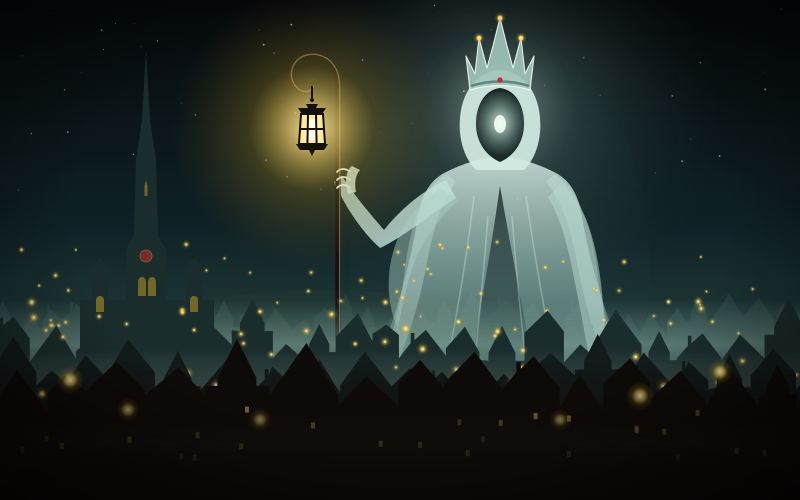
The fog-drowned city of Vellmoor at night, its crooked rooftops and cathedral spire pricked with drifting lantern lights beneath a tall, crowned figure of pale mist holding a great lantern on a crook.

Prologue

The City That Never Goes Dark

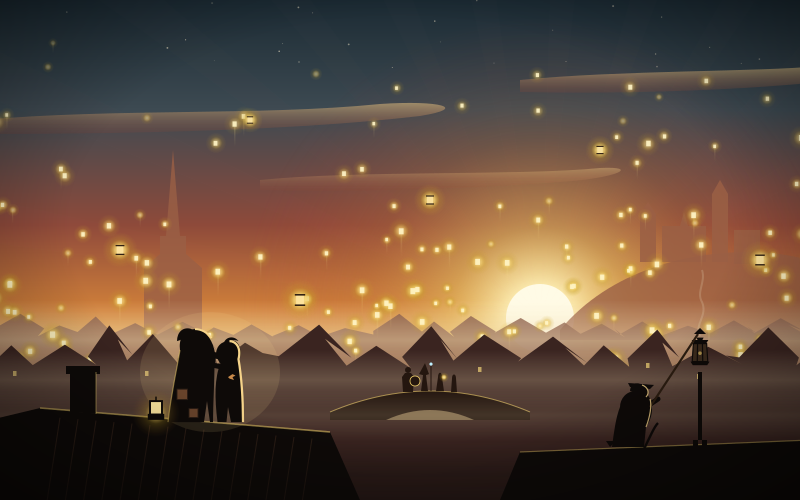
They tell it in the river towns on cold nights, when the shutters are latched and the fire is banked high. Far up the valley, where the river slows and splits into a hundred canals, there is a city called Vellmoor. Its gables lean together like old women sharing secrets, its bridges are worn smooth as river stones, and above it all a cathedral spire stabs up through the fog toward a palace on the hill. And in Vellmoor, they say, the lights never go out.

Long ago a plague came to that city. It crept along the canals and through the bakeries and nurseries, and the bells of Saint Orlen rang for the dead until the ropes frayed. The good King Aldric walked among the sick with a lantern in his hand, promising that the dark would not last. Then, one night, the plague simply stopped. The people wept with joy. They did not ask what their king had paid.

But the fog that rolled in that night never rolled back out. It settled over Vellmoor like a damp grey wool, and in it, small lights began to drift: soft golden lanterns, bobbing at the ends of alleys, hanging over the water, waiting at the corners of dreams. They were warm. They were beautiful. And those who followed them were never seen again.

Travellers still go to Vellmoor. Merchants, pilgrims, the curious and the brave. Most of them come back with tales of empty streets and a city that glows all night long like an ember that will not die. A few come back quieter than they left. And some, the storytellers say, lowering their voices, are still there now, shining in the fog, waiting for someone to bring them home.
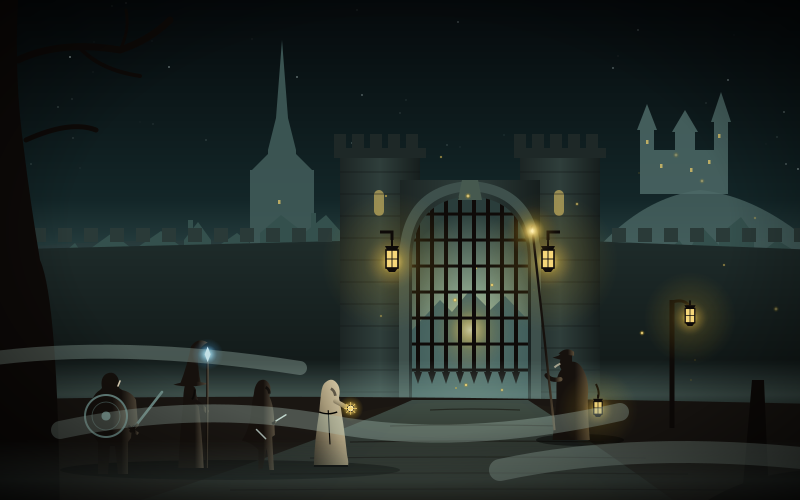
A great iron city gate looming out of the fog at dusk, an old bent lamplighter with a long lighting pole and lantern standing beside it as the party approaches.

Chapter 1 of 9

The Lamplighter's Warning

The road to Vellmoor ran out of daylight a mile before the walls. By the time the party reached the gate, the fog had thickened until Grath could barely see the rim of his own round shield. The gate itself rose out of the murk like the ribs of some drowned beast, black iron worked into thorns and crowns, beaded with cold water. Sister Maren lifted her sun-disc and its soft gold glow pushed the grey back a single, grudging pace.

“Cheerful place,” Corvin Ash murmured from beneath his hood. His hands had not strayed far from his twin daggers since they had left the river road. Ilsabet Thorne said nothing; she was watching the blue crystal on her staff, which had begun, very faintly, to hum.

A shape moved beside the gate. Grath stepped forward, shield raised, but it was only an old man, bent nearly double, leaning on a lighting pole twice his height. A small brass lantern swung from its hook, and his face beneath a sodden cap was creased like old leather. “Evening,” he rasped. “Name’s Hobb. I light the lamps on this side of the canal. Have done for forty years.” He squinted at Maren’s glowing symbol and something in his face softened. “Dawn-folk. Haven’t seen one of you in a long while.”

He reached up with his pole and lit the gate lamp, and then he caught Maren’s sleeve with fingers like twigs. “Listen to me. You’ll see lights in there tonight. Little ones, floating. Pretty as anything. They’ll look like home. Don’t follow them.” His voice cracked. “Whatever you hear, whoever you think is calling, don’t follow the lights.”

Behind them, the iron gate groaned open on its own. Old Hobb flinched and did not look at it. The party exchanged a glance, and then Grath, who had never in his life turned back from a door, walked through first.

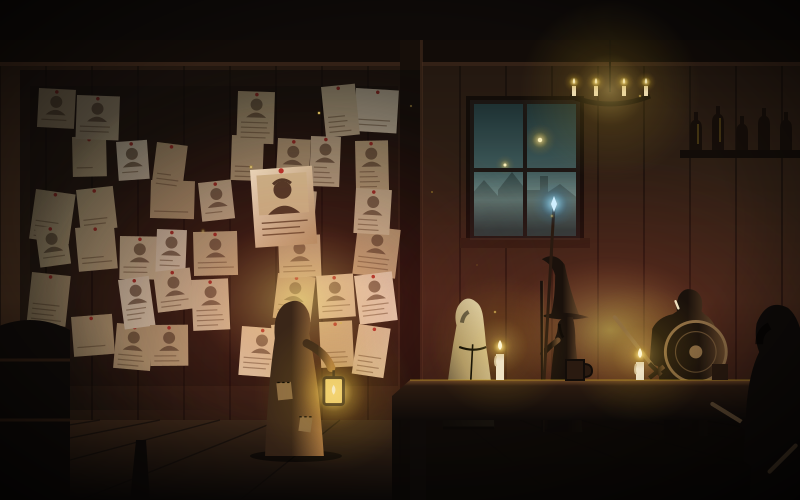
A candle-lit tavern interior with a wall covered in pinned missing-person notices, where a small girl holding a candle-lantern faces the seated party.

Chapter 2 of 9

The Guttered Candle

The only open door on the street belonged to a tavern called the Guttered Candle. Inside it was warm and low-beamed and smelled of tallow and boiled cabbage, and every candle in the room had burned down to a stub. A handful of drinkers hunched over their mugs and did not look up. It was Ilsabet who noticed the wall first. She rose from the table, her tall hat brushing a rafter, and stood before it in silence.

Notices. Hundreds of them, pinned one over another until the plaster had vanished beneath the paper. Faces sketched in charcoal, names in shaking hands. Missing since the harvest fair. Last seen near the Fishgate bridge. Please, if you see her. Some were so old the ink had faded to ghosts of letters. Corvin read a few over her shoulder and stopped making jokes.

The door opened and the cold came in, and with it came a girl of perhaps twelve in a cloak so patched it looked like a quilt. She carried a small candle-lantern in both hands, as carefully as if it held a bird. She looked at the party, at Maren’s robe and Grath’s tusks and Ilsabet’s staff, and she walked straight to their table. “You’re not from here,” she said. “Everyone from here has given up.”

Her name was Wren. Her brother Tam had gone out three nights ago to fetch water from the canal and had not come home. “He saw a light,” she said, and her chin trembled but did not break. “He said it looked like Mam’s lamp, from before. He went after it. I was asleep.” She set down her lantern. “I’ve got four coppers and I’m not scared. Please. Help me find him.”

Grath looked at the four coppers on the table for a long moment. Then he pushed them gently back toward her with one enormous finger. “Keep your money,” he rumbled. “We’ll find your brother.” Maren took the girl’s cold hands in hers, and for the first time that night, the candle-stubs in the tavern seemed to burn a little brighter.

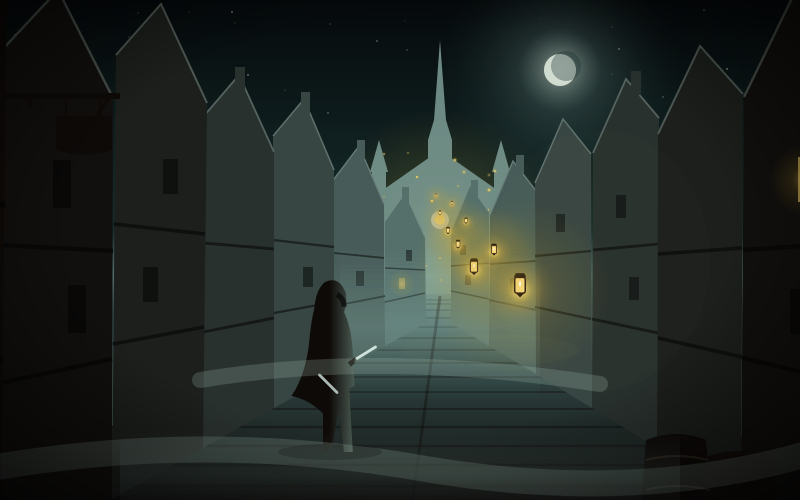
A narrow, fog-filled alley between leaning houses with small floating lanterns drifting away into the mist and a hooded figure following them.

Chapter 3 of 9

Following the Lights

At midnight the bells of Saint Orlen rang thirteen times, and the lights came out. From the tavern’s upper window the party watched them rise from the canals: small golden lanterns with no hands to carry them, bobbing up from the water, sliding out of chimneys, gathering in the streets like moths around a flame no one could see. Wren pressed her face to the glass. “They come every night,” she whispered. “Every single night.”

“Someone has to see where they go,” Corvin said, already fastening his cloak. Maren started to object, remembering Old Hobb’s warning, but the rogue only smiled. “I’m not following them. I’m following them carefully. There’s a difference.” Before anyone could argue, he was out the window and gone across the wet roof tiles without a sound.

The alleys of Vellmoor were narrow enough that the houses almost kissed overhead. Corvin moved through them like a shadow, keeping a dozen paces behind a cluster of drifting lights. Up close they were stranger than he had expected. Each lantern held not a flame but something softer, a slow pulse of light that brightened and dimmed like breathing. And from one of them, as it passed, he heard a voice, tiny and far away: “Is it morning yet? I want to go home.”

He nearly turned back then. Instead he gripped his daggers until his knuckles ached and kept going, over a footbridge, along a canal, up a flight of steps worn hollow by centuries of feet. The lanterns poured into the cathedral square from every street at once, hundreds upon hundreds, and flowed like a river of gold through the broken doors of Saint Orlen. Then the doors closed, and the square went dark.

When Corvin slipped back through the tavern window an hour before dawn, his face was pale under the hood. “They’re people,” he said quietly. “The lights. I think they’re people.” Wren’s lantern trembled in her hands, but she did not cry. “Then Tam’s in there,” she said. “And we’re going to get him out.”

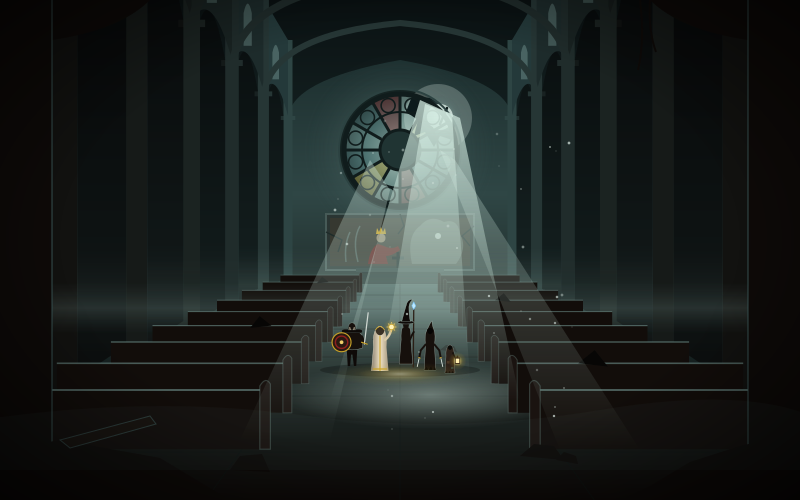
A ruined cathedral nave lit by moonlight streaming through a broken rose window, rows of old pews, and the party standing small in the long aisle.

Chapter 4 of 9

The Cathedral of Saint Orlen

They went the next night, all five of them, Wren walking close behind Maren with her candle-lantern held high. The great doors of Saint Orlen were not locked. They swung inward at Grath’s touch, and the party stepped into a silence so deep it seemed to press against their ears. The nave stretched away into shadow, its pews cracked and furred with dust. High above, the great rose window had shattered long ago, and moonlight fell through its broken petals in pale, cold shafts.

The lanterns were gone. There was no sign of the golden river Corvin had seen, only the smell of old wax and wet stone and something sweeter underneath, like flowers left too long on a grave. Ilsabet raised her staff and the blue crystal flared, throwing light across the walls. Wren gasped.

The frescoes covered every surface. In the first, a crowned king walked among the sick, a lantern in his hand. In the next, he stood alone on a bridge at night, his face turned toward the fog. In the last, the largest, he knelt. Before him rose a shape painted in greys and whites, vast and faceless, with too many arms reaching out of the mist. In its hands it held a lantern that blazed brighter than the sun, and the king was reaching for it.

“King Aldric,” Maren breathed. She knew the name from the dawn-temple’s old records: a good king, a kind one, lost to history. “He made a bargain.” Ilsabet traced the painted lantern with one long finger. “With the Fog itself,” she said. “That is no ordinary spirit. That is something old.”

Grath was the one who found the stairs, behind the altar, spiralling down into darkness. Cold air breathed up from them, and with it, so faint they almost missed it, the sound of a quill scratching on paper. “Someone’s still writing,” Corvin whispered. Grath lifted his shield and started down.

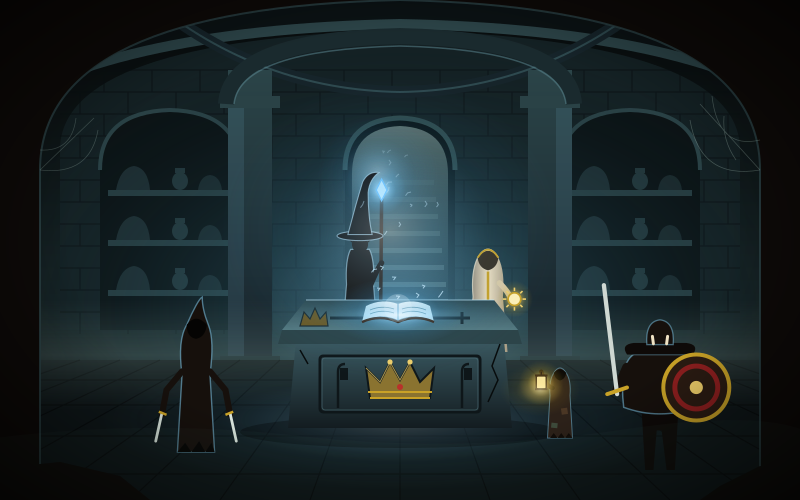
A stone crypt holding a royal sarcophagus carved with a crown, and an open book glowing blue in the light of the wizard’s staff.

Chapter 5 of 9

The King's Diary

The crypt beneath Saint Orlen was older than the cathedral above it. Niches lined the walls, each holding the dust of some long-dead bishop, and at the far end, on a dais of black stone, stood a sarcophagus carved with a crown. The lid had been pushed aside from within. The coffin was empty. Resting on its edge, as though someone had only just set it down, lay an open book, and beside it a quill still wet with ink.

Ilsabet approached it with the care of someone handling a sleeping snake. When the light of her crystal touched the pages, the writing shimmered and glowed blue, and she began to read aloud. The first entries were a king’s worries: grain stores, the price of salt, a daughter’s fever. Then the plague. Then the dying. The handwriting grew ragged as the pages turned.

“The physicians have failed. The priests have failed. Tonight my own little Elsbeth stopped breathing for a moment and I thought my heart would stop with hers. There is a voice in the fog on the Bridge of Sighs. It says it can give me a light that never dies. It says no one in Vellmoor will ever go into the dark again.” Ilsabet’s voice faltered. She turned the page. “I said yes.”

The later entries were worse. The plague had ended, but the Fog wanted its price, and the price was light. Every night the king had to feed the great lantern, and the only fuel it would take was the glow of living souls. At first he chose criminals. Then strangers. Then anyone. The last pages were barely words at all, just the same line over and over in a hand that was no longer quite human: Keep them safe. Keep them lit. Keep them forever.

“He thinks he’s protecting them,” Maren said softly. “Even now.” Wren stood very still, staring at the empty coffin. “Then he’s got Tam because he thinks Tam would be safer in a lantern,” she said. “That’s stupid. That’s the stupidest thing I ever heard.” Nobody disagreed. Corvin found the last loose page tucked in the back cover: a map of the old city, and on it, marked in shaking ink, a place called the Lantern Market.

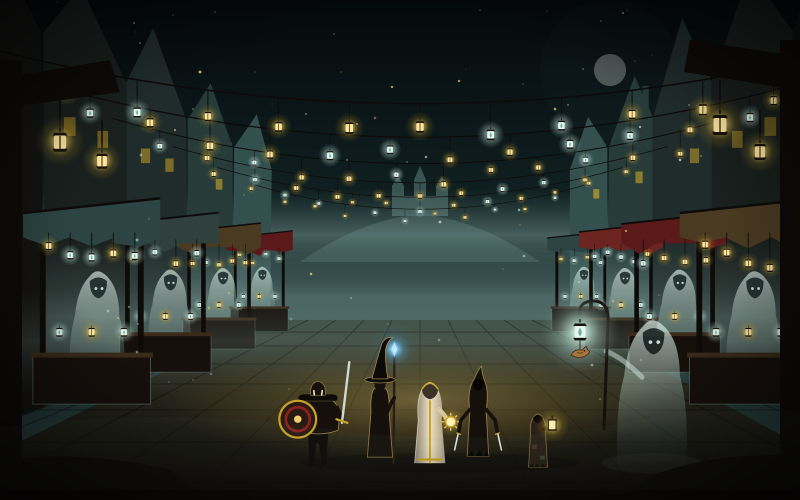
A spectral night market of stalls hung with hundreds of glowing lanterns, translucent ghostly merchants behind the counters, and the party walking through.

Chapter 6 of 9

The Lantern Market

The map led them to a square by the old harbour that should have been empty. At the stroke of midnight it was not. Stalls rose out of the fog as if they had always been there, draped in faded silk, and from every hook and beam and rafter hung lanterns, hundreds of them, glowing softly, each one breathing its slow golden breath. Behind the counters stood the merchants: tall, thin, see-through as frost on glass, with smiles painted on faces that did not move.

“Fresh light, fresh light,” they murmured as the party passed. “A fisherman’s laugh, very warm. A grandmother’s lullaby, burns all winter. Trade you, trade you.” One reached a pale hand toward Wren’s little candle-lantern, and Grath stepped between them so quickly that the ghost flinched back like smoke in a draught.

Corvin did what Corvin did best. While Ilsabet engaged a spectral merchant in a long, extremely polite conversation about the exchange rate of memories, he drifted along the stalls with his hands in his pockets, eyes moving over every lantern. Maren held her sun-disc close beneath her robe, letting only a sliver of its light escape, enough to keep the cold from settling in their bones.

It was Wren who found it. She stopped dead in front of a stall at the market’s heart and made a small sound, as if she had been struck. Hanging from a hook among a hundred others was a lantern no different from the rest, except that tied to its handle with a bit of string was a tiny wooden bird, clumsily carved, one wing a little shorter than the other. “I made that,” Wren whispered. “For his birthday. I made that.”

The lantern pulsed, brighter, as if it had heard her. The merchant behind the stall turned its painted face toward them. “Not for sale,” it said. “That one belongs to the King. They all belong to the King.” And all around the market, every ghostly head turned, every painted smile widened, and the lanterns began, one by one, to drift up and away toward the palace on the hill.

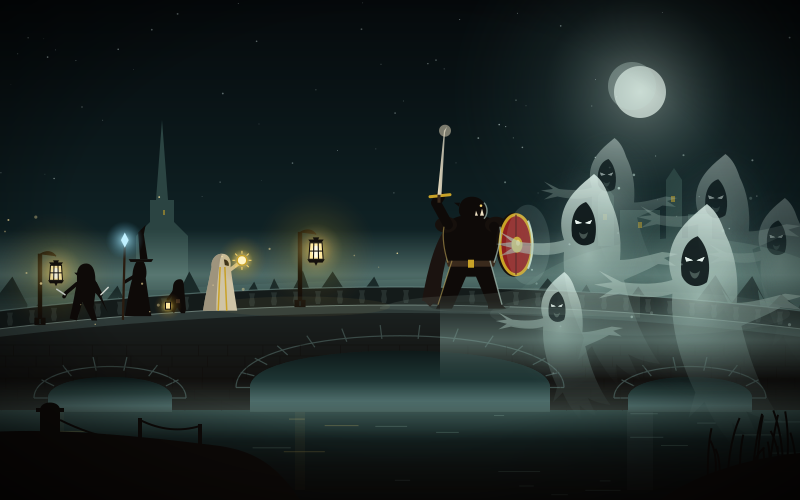
An arched stone bridge over a dark canal where a broad fighter with a round shield stands facing wispy wraiths rising out of the fog.

Chapter 7 of 9

The Bridge of Mist

They ran. Through the market’s collapsing stalls, up the harbour steps, along the canal, chasing the river of lights toward the palace. Wren clutched her candle-lantern to her chest and kept pace without complaint. The only road to the hill crossed the Bridge of Sighs, a high stone arch over black water, the same bridge where, long ago, a desperate king had heard a voice in the fog.

Halfway across, the fog rose up to meet them. It came off the canal in long grey ropes that twisted into shapes: arms, shoulders, hollow faces with mouths like open wounds in the mist. Fog wraiths, dozens of them, their cold so fierce that frost raced across the bridge stones. One swept through Corvin and he dropped to one knee, gasping, his breath gone white. Ilsabet’s crystal blazed and a bolt of blue fire tore a wraith apart, but two more coiled up in its place.

“There’s too many!” Corvin shouted. Grath looked back along the bridge, at the wraiths boiling up from both sides, and then forward, at the palace gate. He set his feet. He lifted his round shield. “Then go,” he said. “I’ll hold the bridge.”

“Grath, no,” Maren began, but the half-orc only grinned, tusks bright in her sun-glow. “Go, priest. That girl’s brother is waiting.” He turned his back on them and swung his longsword through the nearest wraith with a roar that shook frost from the parapet. The creatures shrieked and surged toward him, and he met them like a rock meets the tide.

The others ran. Behind them they heard the clang of steel on stone, the wraiths’ thin wailing, and over it all Grath’s voice, bellowing an old marching song from his mercenary days, off-key and defiant. Wren looked back once. Through the fog she saw only a broad silhouette behind a round shield, unmoving, while the grey storm broke around him. “He’ll be all right,” she said fiercely, to no one. “He will.”

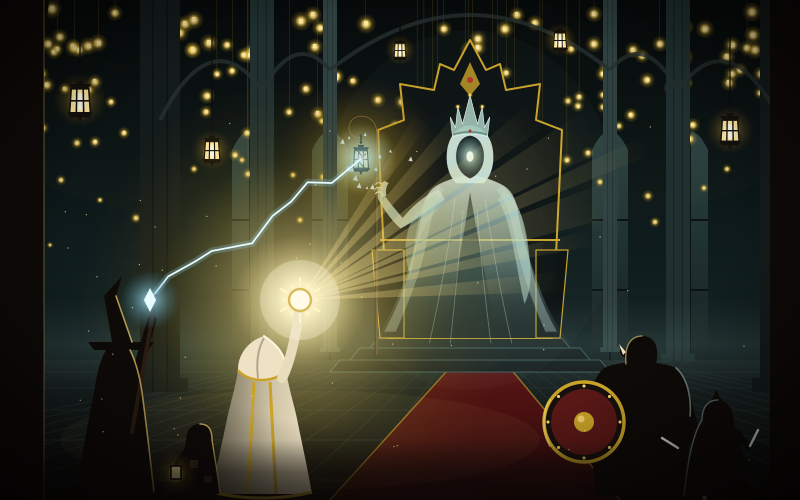
A vast throne room with a ceiling of hanging lanterns like stars, the spectral king seated on his throne, and a cleric holding up a blazing sun symbol before him.

Chapter 8 of 9

The Throne of Ten Thousand Lights

Lanterns hung from the vaulted ceiling of the throne room by the thousand, like a night sky pulled down close enough to touch, and every one of them was breathing. At the far end, on a throne of white stone, sat the Lantern King. He was tall and terribly thin, made of pale mist held together by a crown, and where his face should have been there was only a cold, steady glow. Across his knees lay a crook, and from it hung a great lantern, burning brighter than all the rest together.

“You should not have come,” he said, and his voice was the sound of fog against glass. “Out there is plague and dark and dying. Here, no one is ever lost. Here, everyone shines forever.” He raised the crook, and the throne room filled with a cold so deep that Ilsabet’s staff frosted over in her hands.

Sister Maren stepped forward. She lifted her sun-disc high above her head and spoke the oldest prayer of her order, and the dawn answered. Gold light poured from the holy symbol, flooding the hall, burning through the mist, and for one moment the faceless glow of the Lantern King flickered, and beneath it was a face: tired, grey-bearded, very sad. “Aldric,” Maren said. “Your Elsbeth lived because of you. But she grew up, and grew old, and died in the sunlight, as she should. Let them go.”

The king faltered. In that heartbeat, Corvin darted across the floor and hooked the great lantern from the crook with one dagger, sending it spinning through the air, and Ilsabet, who had been waiting for exactly this, swung her staff like a hammer. The blue crystal met the bargain-lantern with a sound like a bell breaking. Light exploded outward. Somewhere far away, something old and hungry screamed, then fell silent.

When the glare cleared, the Lantern King was kneeling. The mist was thinning from him like breath on a winter window, and his face was a man’s face now, wet with tears. “I only wanted them safe,” Aldric whispered. Wren walked up to him, her little candle-lantern held out. “Safe isn’t the same as alive,” she told him. The old king looked at her for a long time. Then he nodded, closed his eyes, and let go.

The rooftops of Vellmoor at sunrise with hundreds of lanterns rising like sparks into a golden sky and two children hugging in the street below.

Chapter 9 of 9

Dawn over Vellmoor

The lanterns opened all at once. Ten thousand tiny doors swung wide, and the light inside each one rose up through the palace ceiling as if it were not there, out over the city, into a sky that was turning, for the first time in a hundred years, from grey to pink to gold. The fog was lifting. It peeled back from the canals and the crooked gables and the cathedral spire like a sheet drawn off a sleeper, and the sun came up over Vellmoor.

Down in the streets, the light came home. People stumbled out of doorways and onto bridges, blinking, bewildered, still in clothes from a dozen different decades: a fisherman with his net, a baker dusted in flour, a girl in a harvest-fair dress. Some of the oldest lights did not come down at all. They simply rose higher, brighter, and faded gently into the morning, and somehow that felt right too.

Grath was waiting at the foot of the Bridge of Sighs, his shield dented and his armour rimed with melting frost, grinning like a fool. Corvin pretended he had not been worried. Ilsabet looked at her cracked crystal and decided it had been worth it. Maren lowered her sun-disc at last and let the real sun do the work.

Then a small voice called out from the canal steps: “Wren? Wren!” A boy in a damp nightshirt stood there, rubbing his eyes, a wooden bird with one short wing clutched in his fist. Wren dropped her candle-lantern on the cobbles and ran. She hit her brother so hard they both nearly went into the water, and she held on, and held on, and did not let go for a very long time. “You stupid,” she sobbed into his shoulder. “You stupid, stupid, you’re home.”

Up on the gate road, Old Hobb set his lighting pole against the last lamp still burning in Vellmoor. He looked at the sunrise for a long moment, and a smile cracked his leathery face. Then, gently, he snuffed it out.

The End… of This Telling

Your Party's Turn

The fog has lifted from Vellmoor, but somewhere out there other lights are still drifting in the dark. Gather your lanterns, choose your heroes and bring your table to the city that never goes dark.

More Illustrated Tales